The Sherpa Verdict
- • Low handicappers
- • Mid handicappers
- • High handicappers
Hole 2 (par 5) - The wind off the sea will blow your ball towards the burn, play more safe to the right that you would expect to.
High-end Luxury (£££)
Playing Conditions
Our Strategy
Golf has been played at The Machrie since 1891 and you quickly realise what every other golfer who visits has, that brute strength isn’t the main currency here. Distance helps, as it does anywhere, but the Machrie is really about imagination and control. The wind is almost always present, and the ground game is your friend. You’ll need to accept that sometimes the ball will kick in directions you didn’t quite plan but that’s half the fun. Play like Tom Morris, keep it low and keep it rolling & you'll be surprised with the results given how playable the course can be. Regardless of the score you’ll shake hands on 18 with a smile on your face.
Review
There are plenty of great links courses in Scotland. What there aren’t many of are top ranked UK courses that make you slow down, look up from your scorecard, and realise the golf is only part of the story. The Machrie on Islay is one of those rare spots. It feels remote without being inconvenient, luxurious without being flashy, and serious about golf without taking itself too seriously. It’s the kind of place you come for a round and end up wishing you’d booked three nights instead of one.
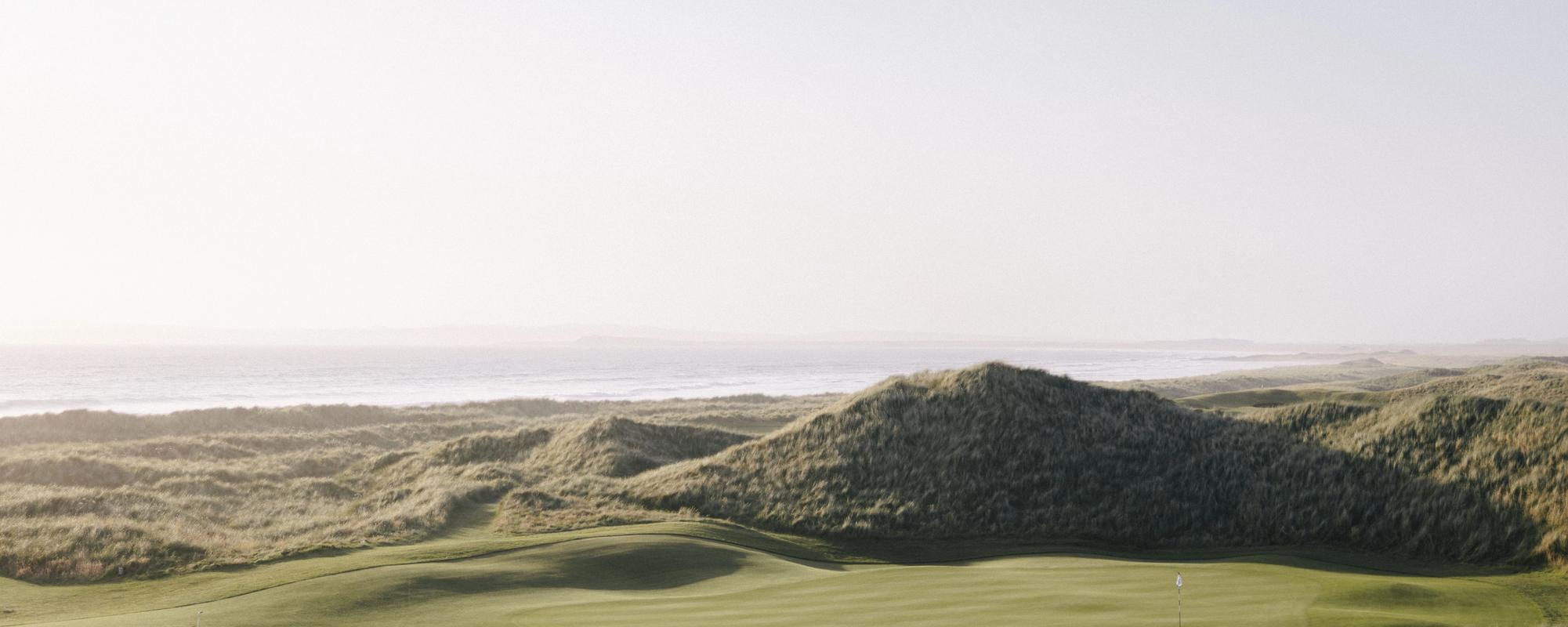
The modern Machrie was redesigned by D.J. Russell, but the soul of the place still stretches back to 1891. It doesn’t feel manufactured or overly manicured, yet clearly plays like it. It feels like a proper links course that’s been shaped by wind, sand, and time. The fairways roll naturally, the greens sit into the land rather than on top of it, and the dunes frame holes in a way that looks completely unforced.
One of the early reminders of that comes at the 2nd, a par 5 that looks generous but has a burn waiting to collect anything pushed left by the sea breeze. It’s a classic links dilemma. Do you take on the bold line, or play safely right and accept a longer route to the green. The course asks these kinds of questions all day.
By the time you reach the 7th, you start to see the Machrie’s sense of humour. It’s a drivable par 4 in the right conditions, and from the tee the temptation is obvious. But anything that runs off the left side leaves a brutal chip back up a green that falls away from you. It’s the sort of hole that looks innocent on the card and causes more damage than the long ones.
The stretch from the 8th through the 9th is where the course really shows its teeth. The 8th is a narrow, thoughtful par 4 that demands two committed shots. The drive is played through a generous enough fairway, but the real test comes with the approach. There’s a huge swale guarding the front of a three-tiered green, and anything under-hit is simply not getting there. It’s one of those holes where the green looks bigger from the fairway than it did from the tee, but once you’re putting, you realise how subtle the tiers are. It’s not a hole you overpower. You have to place the ball and trust your distance.
Then comes the 9th, a downhill par 3 that is as much about nerve as it is about yardage. You’re hitting toward the sea, with the dunes and horizon creating a view that can easily distract you. The green is large, but it’s ringed by trouble. Long and you’re in the heather. Short and you’re scrambling up steep, awkward slopes. The wind plays tricks here, and it’s the kind of hole you could happily stand on the tee and hit three or four balls just to see how different each one behaves.
It’s not just the views that make the Machrie memorable. The course is in excellent condition, right up there with Scotland’s best, but it still retains that rugged, authentic links feel. It’s not polished to the point of losing its character. You still get those bouncy lies, the odd awkward stance, and the sense that you’re playing over real ground rather than something engineered to look like it.
The back nine continues in the same spirit. Holes weave through dunes, open out toward the sea, then tighten again. There’s constant variation. Some holes feel wide and inviting. Others feel like you’re threading a ball through a moving landscape.
The 15th is a good example of the Machrie’s green complexes. The putting surface is protected by swales to the left and runoff to the right, and if you miss it, your short game is properly tested. But it never feels unfair. There are always options, and often more than one way to play the recovery.
Then there’s the 17th, one of the most talked-about holes on the course. It’s a short par 4, but it’s full of drama. From the tee, you’re aiming over a ridge line on the left side of the fairway. If you carry it, you’re rewarded with a clear view of the green and a great chance at birdie. Miss that line, and you’re left with a blind approach over dunes, hoping you’ve picked the right club. It’s a throwback links hole, full of risk and reward, and it’s exactly the kind of design that sticks in your memory.
What makes the Machrie particularly appealing for golf tourists is how relaxed the whole experience feels. You never feel rushed. It’s easy to get into a rhythm here. The course is walkable, the views constantly change, and there’s a sense that you’re playing in your own corner of the world.
Off the course, the hotel complements the golf perfectly. The restaurant and bar overlook the course and Laggan Bay, and it’s the sort of place where you can sit with a drink after the round and watch the light change over the dunes. Local seafood features heavily on the menu, and the atmosphere is relaxed rather than formal.
For those who like to keep the clubs in hand, there’s also the Wee Course, a six-hole par 3 layout just a short walk from the hotel. It’s ideal for warming up or settling friendly bets in the evening. The Hebrides putting course, a scaled-down replica of the championship course, adds another playful element to the practice facilities, which are extensive and match the conditions of the main links.
Recovery options are equally strong. The outdoor sauna, hot tubs, and cold plunge area give the place a slightly Scandinavian feel, and after a day in the Atlantic wind, it’s exactly what you want. There’s also a clubhouse sauna and treatment rooms using local seaweed-based therapies.
Must Know Tips
- 1Hole 2 (par 5) - The wind off the sea will blow your ball towards the burn, play more safe to the right that you would expect to.
- 2Hole 7 (par 4) - While driveable in favourable conditions, beware of the runoff to the left of the green. From there, the resulting chip is incredibly difficult with the green running away from you.
- 3Hole 15 (par 4 ) - Swales to the left and runoff to the right protect the green. Miss it and expect your short game to be tested, albeit one with interesting options.
- 4Hole 17 (par 4) - Aim to drive over the ridge line on the left half of the fairway. Anything short or right of it will leave a blind shot over the dunes.
- 5Hole 9 (par 3) - Distance control is essential, miss the green long and there is little chance of recovery from the surrounding dunes.
Signature Holes
Hole 8
A narrow test of precision with huge swale before a tricky to navigate three-tiered green - don't be short!
Hole 9
A breathtaking downhill par 3 where you aim out to sea and hope you’ve judged it right
Hole 17
A short but nerve-testing par 4 over hidden ridges, is pure links drama and is risk and reward in perfect balance.
